

Series directed by Elena Svalduz, President of Aisu, Massimiliano Savorra, Vice-President of Aisu
Scientific committee: Alfredo Buccaro, Giovanni Cristina, Cristina Cuneo, Marco Folin, Andrea Longhi, Andrea Maglio, Elena Manzo, Luca Mocarelli, Heleni Porfyriou, Marco Pretelli Marco, Donatella Strangio, Ines Tolic, Stefano Zaggia
The aim of the Insights collection is to present studies treating very broad topics in urban history on which recent developments in research into the multiple branches of the field have been drawing new findings. Its volumes are designed to be inclusive of a considerable number of contributions reflecting the various and varied geographies, aspects and connections, segments and priorities revealed by research responding to a specific impetus for that given theme at that particular moment.
All papers to be published will undergo Double Peer Review.
The volumes can be downloaded in the section DOWNLOAD nel menù EDIZIONI.
 La città dei giuristi / The city of the lawyers 2026 | La città dei giuristi / The city of the lawyers a cura di / edited by Marco Folin, Sara Menzinger. The second conference, from which this collection originates, was held in May 2025 at the Department of Law of Roma Tre University and was devoted to the theme The City of Lawyers / La città dei giuristi. As the second stage of the broader project promoted by AISU, the conference focused on the relationship between legal history and urban history, bringing together historians, architects, urban planners, archivists and legal scholars to examine, from different disciplinary perspectives, the many ways in which law contributes to defining, organizing, governing and transforming urban space. |
 | La città degli storici dell’arte / The city of art historians a cura di / edited by Bianca de Divitiis, Marco Folin. The first conference, which gave rise to this collection, took place on May 29 and 30, 2024, at the Federico II University of Naples and was dedicated to the theme of The City of Art Historians. It is no coincidence that this was chosen as the first step in a broad and complex project, by virtue of a close and consolidated, though not obvious, relationship between art history and other possible fields of study that contribute to defining the vast field of research of urban history. |
| La città degli storici dell’arte / The city of art historians 2025 | |
 | L’opera Oltre lo sguardo / Beyond the Gaze a cura di / edited by Alessandro Ippoliti, Elena Svalduz includes 6 Books. Tomo 1- La città prisma / The prism city a cura di / edited by Francesca Romana Fiano Tomo 2 – La città misurata / The measured city a cura di / edited by Marta Calzolari Tomo 3 – La città stratificata / The layered city a cura di / edited by Veronica Balboni Tomo 4 – La città corpo / The city as a body a cura di / edited by Benedetta Caglioti Tomo 5 – La città immaginata / The imagined city a cura di / edited by Elena Dorato Tomo 6 – La città rappresentata / The represented city a cura di / edited by Giorgia Sala The volumes collect some of the texts that followed the discussions at the conference in Ferrara. |
| Oltre lo sguardo / Beyond the gaze 2025 | |
 | L’opera Città che si adattano? / Adaptive Cities? a cura di / edited by Rosa Tamborrino comprende 4 Tomi. Tomo 1- Adattabilità o incapacità adattiva di fronte al cambiamento / Adaptability or Adaptive Inability in the Face of Change, a cura di Cristina Cuneo Tomo 2 – Adattabilità in circostanze ordinarie / Ordinary Conditions Adaptability, a cura di Chiara Devoti e Pelin Bolca Tomo 3 – Processi urbani di adattamento e resilienza tra permanenza e precarietà / Urban Processes of Adaptation and Resilience Between Permanence and Precariousness, a cura di Andrea Longhi Tomo 4 – Strategie di adattamento e patrimonio critico / Adaptive Strategies and Critical Heritage, a cura di Rosa Tamborrino I tomi raccolgono alcuni dei testi che hanno fatto seguito alle discussioni nell’ambito del convegno a Torino. |
| Città che si adattano? / Adaptive Cities? 2024 | |
 | Food and cities, the two terms around which this volume is constructed, have been closely linked for thousands of years because the birth of urban centers is the most significant consequence of the first great economic revolution in history, the one that about ten thousand years ago led to the beginning of agriculture and livestock farming, allowing humanity to move beyond the hunter-gatherer condition in which it had lived for hundreds of thousands of years. Indeed, cities, which have existed since antiquity as centers of social stratification (rulers, priests, warriors, merchants, artisans, slaves) and economic diversification (manufacturing and trade on the one hand, and agriculture on the other), are increasingly large concentrations of people who, for the most part, do not cultivate the land but who nevertheless must be fed and sustained. The relationship between food and cities, precisely because of its complexity and remarkable temporal stratification, necessarily requires a multidisciplinary approach, which is also clearly evident in this volume, where we find contributions from archaeologists, economic and urban historians, contemporary and food historians, anthropologists, architects, urban planners, and others. |
| Città e cibo dall’antichità a oggi / Cities and food from past to present 2023 | |
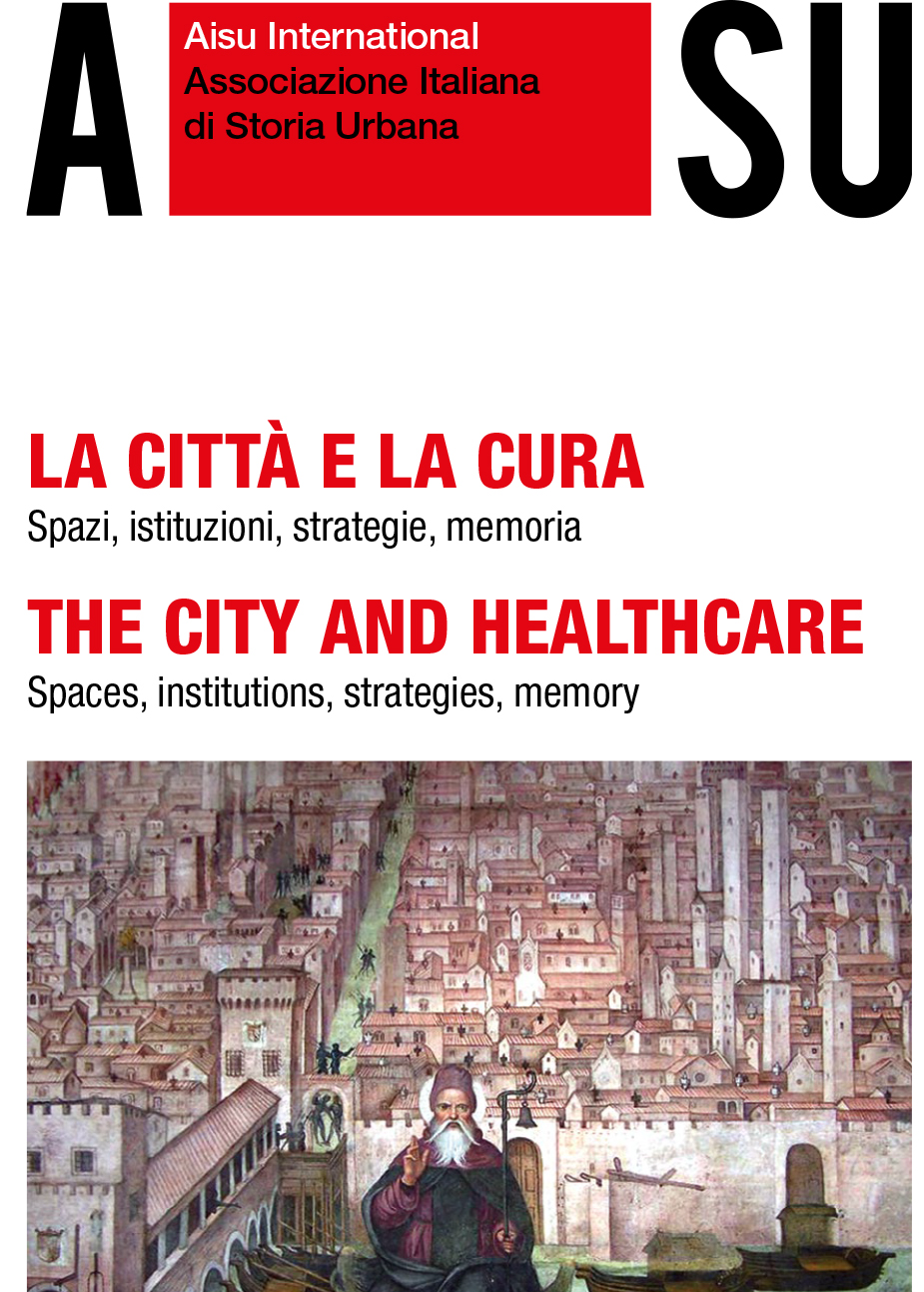 | The city has always been a privileged place for medical treatment, although in some historical moments it was also perceived as a place where the body fell ill; on the other hand, it has developed suitable tools and spaces in which to find remedies for diseases. Political, institutional, cultural and scientific changes have determined in ancient cities and new spaces destined for therapies and well-being. From religious to scientific, the vision and organization of care as a social and cultural theme have generated - in different eras - ways, strategies, practices and customs that have influenced the large scale of urban history, as well as the developments and transformations of different places designated in the cities, or alternatively excluded from the city context. Part of the contributions reworked after the international conference organized by the University of Pavia and the Italian Association of Urban History in September 2020 are collected here. The themes range from issues related to care to spatial and distributive elements or architectural typologies, from social, cultural, institutional and administrative practices in management ordinary and extraordinary impact on neighborhoods or specialized urban areas. The essays as a whole bring out different forms of attention and conception of care - analyzed in the moments of prevention, therapies, emergencies and hospitalization, up to rehabilitation - in different eras and in different geographical and cultural contexts in relation to urban history. |
| “La città e la cura / The city and healthcare” 2021 | |
 | The book is composed of nearly four hundred essays arranged in seven thematic sections which in turn are divided by fifty-five chapters, each of which opens with reflections and comments that clarify the objectives and purposes of the essays included. The book is edited by Marco Pretelli, Ines Tolic, Rosa Tamborrino. |
| “La città globale / The Global City” 2020 |